
Dust mites in Singapore homes: Why humidity matters.

Updated: Aug 12
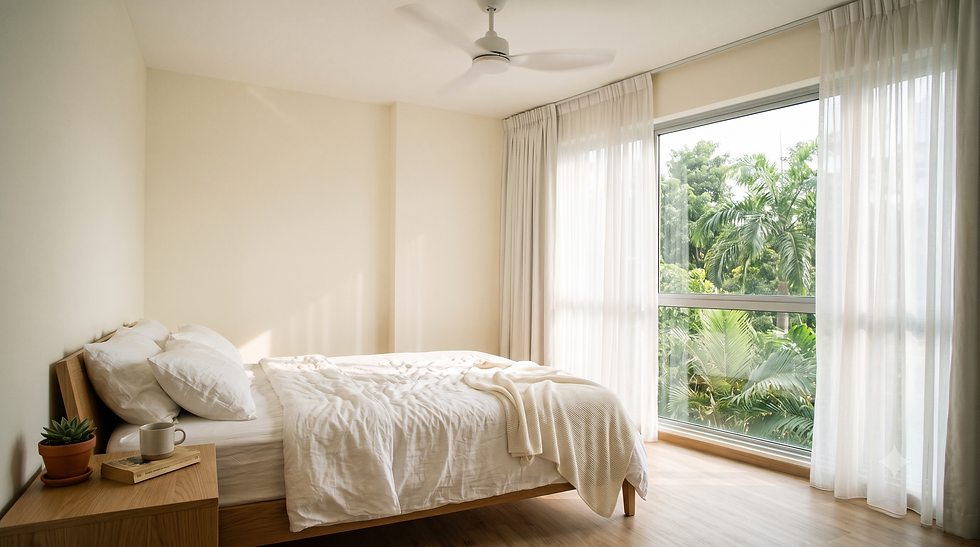
You wake up with a stuffy nose.
Your child scratches at their arms in the middle of the night. Your partner sneezes three times before finishing their coffee.
The air conditioning has been running all night. The floor is clean. You mopped the surfaces yesterday.
And still.
For many Singapore households, dust and indoor allergens can feel like a problem that never quite goes away. You vacuum, wash the bedding, wipe surfaces and perhaps even invest in a HEPA vacuum—yet the symptoms or concerns remain.
There is a reason for this.
Singapore's warm, humid environment is particularly comfortable for dust mites, while the allergens they leave behind can become embedded in mattresses, curtains, sofas and other soft furnishings.
This article explains why dust mite allergens are so persistent here, what actually triggers the reaction, and where probiotic cleaning can fit into a practical home-cleaning routine.
Why Singapore Is a Special Case
Singapore gives dust mites something they need to thrive: warmth and humidity, all year round.
Relative humidity commonly sits around 70–90%, while temperatures typically remain around 25–32°C. Dust mites generally thrive when humidity is above 50% and temperatures are within a warm range.
That matters because many homes have the same conditions throughout the year.
In temperate countries, colder winter months can significantly disrupt dust mite populations. Singapore doesn't get that seasonal reset. The environment remains suitable for dust mites from January through December.
Air conditioning doesn't necessarily change this picture.
Cooler surfaces can create localised areas where moisture accumulates, while fabrics such as mattresses, curtains and upholstered furniture can retain humidity. These soft furnishings also provide dust mites with a source of food: the microscopic skin cells humans naturally shed every day.
The result is a home environment where dust mite allergens can persist even when the house looks perfectly clean.
So if you're cleaning regularly but still worrying about dust mite exposure, you're not necessarily doing anything wrong.
The problem may be what conventional cleaning leaves behind.
What Dust Mites Actually Are—and What They Leave Behind
Dust mites are microscopic arachnids. They are related to spiders and ticks, but they are far too small to see without magnification.
Two common species are Dermatophagoides pteronyssinus and Dermatophagoides farinae.
They commonly live in places where dust and organic material accumulate:
Mattresses
Pillows and bedding
Upholstered sofas and armchairs
Curtains
Carpets and rugs
Soft toys
Other fabric-covered furnishings
They feed primarily on shed human skin cells. We naturally lose skin throughout the day, providing a continuous food source in occupied homes.
Importantly, dust mites themselves are not the main problem for allergy sufferers. They don't bite people or spread disease.
The issue is what they leave behind.
Dust mite faeces and fragments of their bodies contain allergenic proteins, including Der p 1 and Der f 1. For someone who is sensitive to dust mites, exposure to these proteins can trigger an allergic response.
And these particles don't simply disappear when the mite is gone.
Allergenic fragments can remain in dust and become embedded in fabrics. That's why removing visible dust isn't necessarily the same thing as removing the allergen.
A HEPA vacuum can be extremely useful because it physically captures fine particles. Washing bedding can remove accumulated material. Regular cleaning is still important.
But mechanical cleaning primarily removes particles.
It doesn't necessarily break down the allergenic proteins that remain in fabric.
That's where a different approach becomes interesting.
How Probiotic Cleaning Addresses Dust Mite Allergens
This is where AllerClean takes a different approach.
AllerClean uses a biological process in which enzymes produced by probiotics help break down the allergenic proteins associated with dust mites, rendering those proteins inactive.
Think of it as the difference between picking up a stain and breaking down what caused it.
When AllerClean is applied to suitable soft furnishings, probiotic bacteria on the treated surface produce enzymes. These enzymes act on protein-based allergenic material left behind by dust mites.
The process can be simplified into three steps:
1. Apply
AllerClean is applied to suitable textile and soft-furnishing surfaces such as mattresses, sofas and curtains.
2. Enzymes act on allergenic proteins
The probiotics produce enzymes that break down the protein fragments associated with dust mite allergens.
3. Allergenic proteins are rendered inactive
Once the proteins are broken down, they no longer have the same allergenic activity.
This is biological breakdown, rather than simply physical removal.
That distinction matters.
AllerClean isn't intended to replace your HEPA vacuum, washing machine or normal cleaning routine. Instead, it can complement mechanical filtration and cleaning by addressing allergenic proteins that may remain in fabrics.
It also doesn't directly reduce the dust mite population.
Its role is to address the allergen, not to act as a mite-killing treatment.
For households dealing with severe or persistent allergy symptoms, especially children with significant respiratory or skin symptoms, cleaning should also be discussed with an appropriate healthcare professional.
Where to Apply It in a Singapore Home

If you're going to focus your effort, start with the places where people spend the most time surrounded by fabric.
1. Bedroom: Highest Priority
The bedroom is usually the first place to focus because mattresses, pillows and bedding are in prolonged contact with people.
Potential application areas include:
Mattress surfaces and sides
Pillow and bedding surfaces before washing
Bedroom curtains
Upholstered bedroom furniture
Areas around and underneath the bed
Bedding should still be washed regularly. AllerClean is an additional measure for suitable textile surfaces, not a replacement for laundering.
For high-use items, a weekly application can form part of a routine. Lower-traffic soft furnishings may need less frequent treatment, such as monthly application.
Always follow the product's instructions for the specific surface.
2. Living Areas
The sofa may be one of the most overlooked pieces of furniture in the home.
It can accumulate dust, skin particles and allergenic material over time, particularly when the same sofa is used every day.
Consider suitable applications on:
Upholstered sofas
Armchairs
Cushion covers
Curtains and window treatments
Area rugs
Combine this with regular vacuuming and washing of removable covers where possible.
3. Children's Spaces
Children spend a surprising amount of time close to fabrics.
Think about the places where your child reads, sleeps and plays:
Soft toys
Play mats
Reading-corner cushions
Fabric chairs
Children's mattresses and bedding
For a favourite soft toy that goes everywhere with your child, regular washing remains important. For items that cannot be washed frequently, a suitable textile treatment can provide an additional approach to managing allergenic material.
What This Doesn't Do
Being clear about limitations is important.
AllerClean is not a medical treatment for allergies. If someone in your household has significant, persistent or worsening allergy symptoms, speak with a doctor or other qualified healthcare professional.
It also doesn't directly reduce dust mite populations. Its purpose is to address allergenic proteins produced by dust mites and present in settled dust and fabrics.
And it shouldn't be treated as a single solution for indoor air quality.
A sensible approach combines several measures:
Wash bedding regularly
Clean soft furnishings and floors routinely
Use HEPA filtration where appropriate
Manage indoor humidity
Reduce unnecessary dust accumulation
Treat suitable textiles when additional allergen management is needed
For bedding, washing at 60°C or above where the material permits can also be part of a dust-mite management routine.
The goal isn't to create a perfectly sterile home. That's neither realistic nor necessary.
The goal is to reduce avoidable allergen exposure and keep the indoor environment manageable.
Practical Takeaways
Singapore's humidity matters.
Warm, humid conditions allow dust mite populations to persist throughout the year.
The allergen isn't simply the mite.
Proteins in faeces and body fragments are important triggers for dust mite allergy.
Probiotic enzymes take a different approach.
AllerClean helps break down allergenic proteins biologically rather than simply removing particles.
Keep your HEPA vacuum.
Biological allergen management complements mechanical filtration; it doesn't replace it.
Start with soft furnishings.
Mattresses, sofas, curtains and soft toys are practical areas to consider alongside regular washing and cleaning.
Related Articles
AllerClean Textile Spray
AllerClean Surf Spray
Looking for a Practical Way to Manage Dust Mite Allergens?
AllerClean is available for Singapore homes through shop.cleron.asia, with twice-weekly fulfilment.

Comments